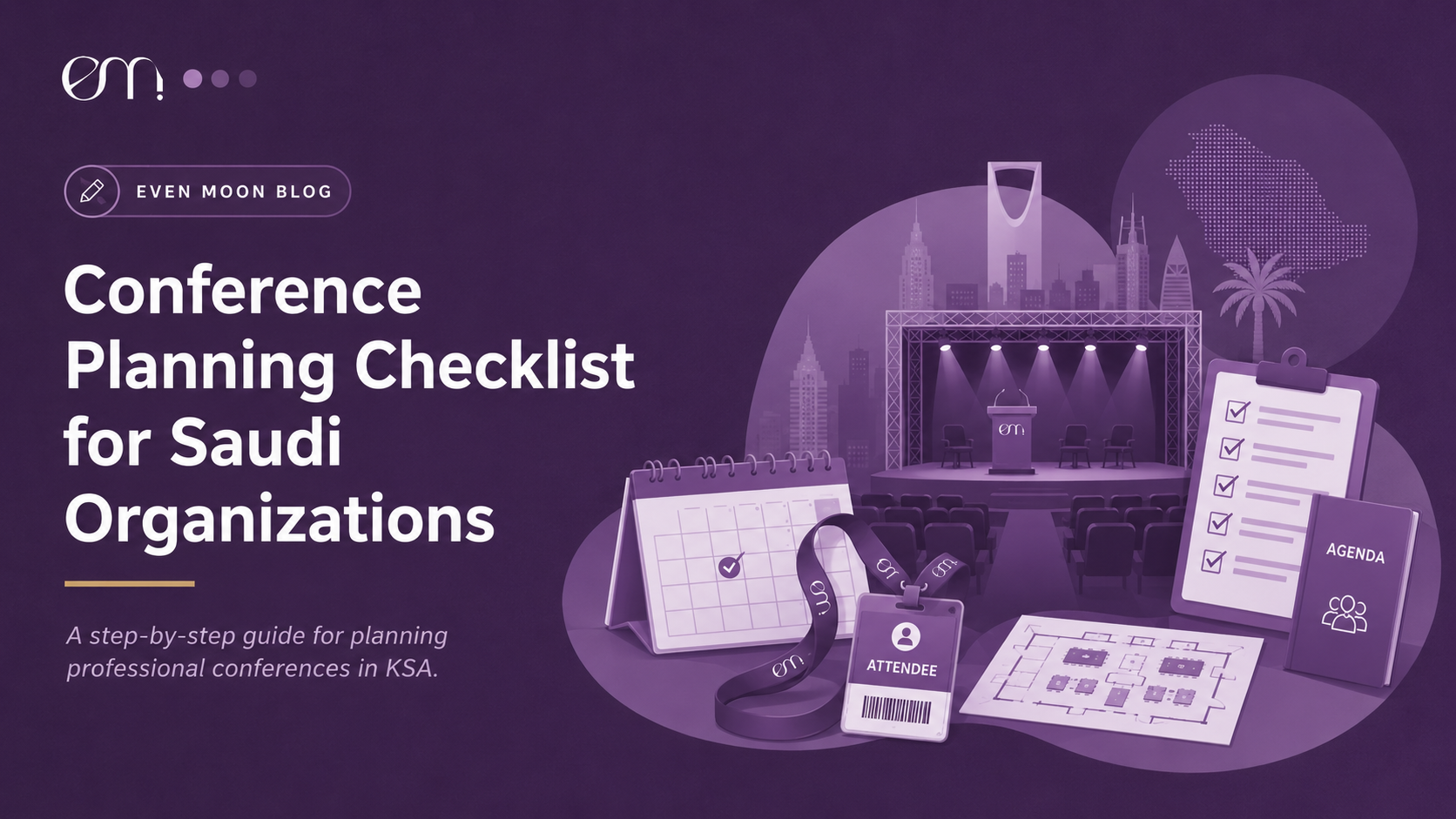
Conference Planning Checklist for Saudi Organizations
A successful conference is built before the first guest arrives. The quality of the agenda, venue, speaker management, registration, technical production, media coverage, and visitor experience all depend on disciplined planning.
For organizations in Saudi Arabia, conference planning requires extra attention to protocol, bilingual communication, guest reception, timing, venue coordination, and measurable outcomes. This checklist gives you a practical framework to plan a professional conference from the first brief to the final report.
1. Define the Conference Objective
Start by writing one clear objective. Without it, the conference becomes a collection of sessions rather than a focused experience.
Examples of strong objectives:
- Position the organization as a thought leader in its sector.
- Announce a strategic initiative.
- Build relationships with partners and stakeholders.
- Educate a specific professional audience.
- Generate media attention around a national or business topic.
- Support sales, recruitment, or investment goals.
Once the objective is clear, define the success indicators. These may include attendance, VIP participation, media coverage, satisfaction score, leads generated, partnerships initiated, or post-event content performance.
2. Identify the Audience
A conference for executives is different from a conference for students, investors, healthcare professionals, educators, or technology teams.
Define:
- Primary audience.
- Secondary audience.
- VIP guests.
- Speakers and panelists.
- Media representatives.
- Sponsors and partners.
- Internal leadership.
This affects everything: invitation style, registration flow, seating, language, content depth, hospitality, protocol, and follow-up.
3. Build the Conference Agenda
The agenda is the heart of the conference. It should balance content value, timing, networking, and audience attention.
A strong agenda includes:
- Opening ceremony.
- Keynote sessions.
- Panel discussions.
- Fireside chats.
- Workshops or breakout sessions.
- Networking breaks.
- Sponsor activations.
- Closing remarks.
Avoid overcrowding the agenda. Long sessions without breaks reduce engagement. A good conference gives attendees space to listen, connect, and move comfortably.
4. Select the Right Venue
Venue selection should be based on more than capacity. The venue must support the full guest journey.
Check:
- Location and accessibility.
- Parking capacity.
- Main hall capacity.
- Breakout rooms.
- VIP entrance.
- Registration area.
- Exhibition or sponsor space.
- Prayer space.
- Catering flow.
- Backstage access.
- Loading area for suppliers.
- Internet strength.
- Audio and visual infrastructure.
In Saudi cities such as Riyadh, Jeddah, Dammam, Khobar, Makkah, and Madinah, traffic and arrival timing should also be considered carefully.
5. Prepare the Visual Identity
A conference needs a clear identity. This includes the event logo, colors, typography, stage screens, digital invitations, badges, signage, social media templates, and presentation covers.
Good conference branding should:
- Reflect the organizer’s identity.
- Support the conference theme.
- Work in Arabic and English.
- Be readable from a distance.
- Stay consistent across print, digital, and on-site materials.
Visual identity is not decoration. It is how the audience recognizes, remembers, and shares the event.
6. Manage Registration and Invitations
Registration must be simple, fast, and reliable.
Prepare:
- Registration form.
- Confirmation email or WhatsApp message.
- QR code or digital badge.
- Guest list segmentation.
- VIP registration process.
- Media registration.
- On-site check-in counters.
- Backup printed lists.
- Support staff for registration issues.
For professional conferences, registration data is also useful after the event. It helps measure attendance, no-show rate, audience profile, and future marketing opportunities.
7. Prepare Speakers and Moderators
Speakers need clear guidance before the conference. Do not assume every speaker understands the time limit, audience profile, technical format, or presentation requirements.
Send each speaker:
- Session title and description.
- Time allocation.
- Audience profile.
- Presentation template.
- Technical requirements.
- Arrival time.
- Green room instructions.
- Contact person.
- Rehearsal schedule.
Moderators should receive discussion points, speaker bios, pronunciation notes, and timing instructions.
8. Plan Technical Production
Technical production is one of the highest-risk parts of conference execution.
Confirm:
- Audio system.
- Microphones.
- Stage lighting.
- LED screens or projection.
- Speaker confidence monitor.
- Clickers.
- Translation or interpretation if needed.
- Recording setup.
- Live streaming if required.
- Backup laptops.
- Backup internet.
- Rehearsal time.
Run a full technical rehearsal before the event. This is not optional.
9. Design the Guest Journey
A conference should feel smooth from arrival to departure.
Map the journey:
- Invitation received.
- Registration completed.
- Arrival at venue.
- Parking or drop-off.
- Entry and check-in.
- Badge collection.
- Wayfinding to hall.
- Seating.
- Breaks and networking.
- Session transitions.
- Departure.
- Follow-up message.
Every unclear step creates friction. A professional event team removes that friction before the guest feels it.
10. Prepare Media and Content Coverage
A conference can create valuable content long after the day ends.
Plan for:
- Photography.
- Videography.
- Social media clips.
- Speaker quotes.
- Media press release.
- Interview corner.
- Sponsor content.
- Event recap video.
- Post-event article.
Content coverage should be part of the plan, not an afterthought.
11. Build the Operational Run-of-Show
The run-of-show is the master execution document. It should include every major timing point and responsibility.
Include:
- Team arrival time.
- Supplier setup time.
- Registration opening.
- VIP arrival.
- Opening ceremony.
- Speaker sequence.
- Break times.
- Media moments.
- Technical cues.
- Catering service.
- Closing.
- Dismantling.
Every team member should know what happens, when it happens, and who owns it.
12. Measure the Results
After the conference, prepare a clear post-event report.
Include:
- Registered guests.
- Actual attendees.
- Attendance rate.
- Audience segmentation.
- Session highlights.
- Media coverage.
- Social media reach.
- Satisfaction survey.
- Operational observations.
- Recommendations.
A conference is not complete when the hall is empty. It is complete when the results are understood.
Final Checklist
Before the event date, make sure you have confirmed:
- Objective and KPIs.
- Audience and guest list.
- Venue and floor plan.
- Agenda and speakers.
- Visual identity.
- Registration system.
- Technical production.
- Hospitality and protocol.
- Crowd flow.
- Media coverage.
- Emergency plan.
- Run-of-show.
- Post-event reporting format.
Final Thought
A successful conference in Saudi Arabia needs clear strategy, strong logistics, professional reception, reliable production, and measurable reporting. The best conference planning teams do not only manage the event day. They control the full experience from the first invitation to the final insight.
You might also like
What Is Crowd Management and Why It Matters for Events in Saudi Arabia
Understand crowd management, visitor flow, safety protocols, wayfinding, access control, and why they are critical for successful events in Saudi Arabia.
Read more
Corporate Event Checklist: From Strategy to Post-Event Reporting
A complete corporate event checklist for Saudi companies planning internal events, annual gatherings, product launches, stakeholder meetings, and brand activations.
Read more
How to Choose the Right Event Management Company in Saudi Arabia
A practical guide for Saudi organizations choosing an event management partner for conferences, exhibitions, corporate events, festivals, and public activations.
Read more